Thursday, July 18, 2013

More Costume Jewelry


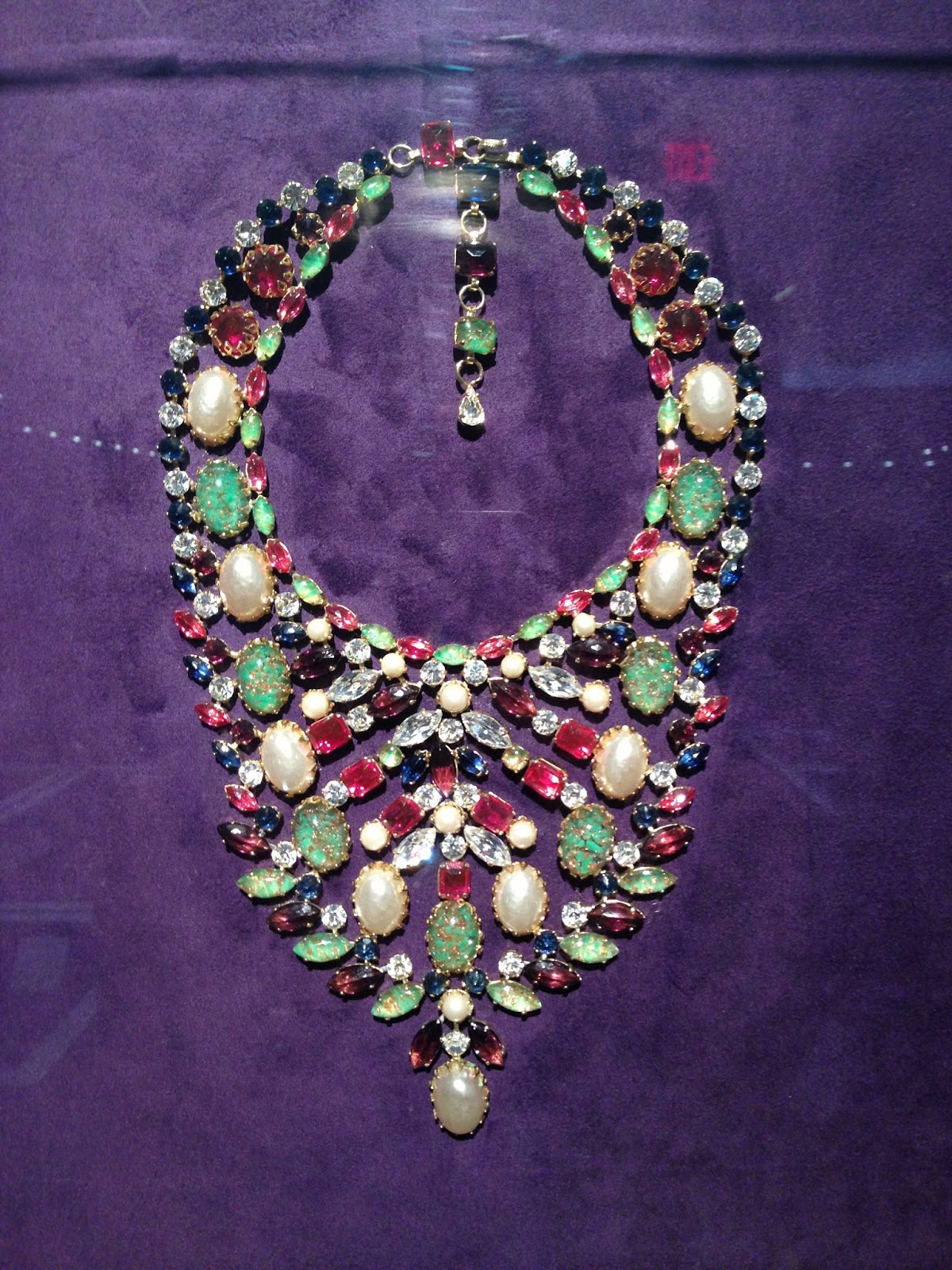
In my last entry, I wrote about gold filled jewelry, which is considered costume jewelry rather than fine jewelry, and I've got costume jewelry on the brain again this week after my recent visit to the Museum of Arts and Design for an truly fantastic exhibit of costume jewelry. The exhibit, titled Fashion Jewelry: The Collection of Barbara Berger, contained hundreds of pieces of costume jewelry made during the 20th century, as well as a group of more recent items. Fashion houses like Yves Saint Laurent and Dior designed and made many of the pieces. Other pieces were made by artists and talented craftsmen who made a name for themselves in costume jewelry, like those at New York company Trifari. The skills to make costume jewelry are quite similar as those to make fine jewelry, and the exhibit reminded me again why design and craftsmanship make jewelry beautiful, not just the materials used to make it. Berger’s pieces are exquisitely made and objects of true beauty. It was a pleasure to visit the exhibit, not only to see such an astounding collection, but to remember that a beautiful piece can always be worth adding to your collection, whether fine jewelry or costume. See below for some of the stunning pieces on display. 

William Delillo (USA) c. 1970 Glass, Lucite, Metal

William Delillo (USA) c. 1969 Glass, Metal

Top: Trifari (USA) c. 1940 Fruit Salad Bracelet, Glass, Metal
Bottom: Trifari TKF (USA) c. 1938 Glass, Metal

Schreiner (USA) c. 1960 Glass, Simulated Pearls, Metal


Monday, July 1, 2013

Gold Filled Jewels


Gold filled jewelry is abundant at Prather Beeland, and I wanted to share with you why we love it! 

Gold filled jewelry is a great and less expensive way to start collecting antique pieces. In the Victorian era, gold was expensive, but skilled craftsmen were not, allowing for beautiful pieces made with impeccable attention to detail but more affordable than pieces made of solid gold. Although the price tag made gold filled jewelry popular with middle class Victorians, the level of craftsmanship and time put into these pieces made them desirable to aristocrats and royalty as well. 

Gold filled jewelry is made using a rolled out layer of gold that is bonded to a base metal, often brass, with heat and pressure. This process leaves the pieces with a thicker layer of gold on the exterior compared to electroplating, a dipping technique that adds a very thin exterior layer of gold using electric currents.  Antique gold filled items have beautiful patina that comes with age, but the gold does not easily wear like gold plated items do.

Below are just some of the gold filled pieces available at Prather Beeland - we hope you'll love them as much as we do!


Thursday, May 16, 2013

All About Paste


Paste has for centuries been a popular and beautiful material used in costume jewelry. Made of flint glass, paste can be either clear or colored. In better quality paste pieces, like these Victorian English earrings, the stones are faceted and polished. Although more fragile than diamonds and other gemstones, paste still sparkles and has beautiful radiance. These earrings are 9K gold with three- part clusters of blue paste. Antique paste is highly collectible today and continues to be a wonderful substitute for diamonds and gemstones.

French jeweler Georges Frederic Strass invented clear paste in 1724, and it soon became all the rage, spreading in popularity to other countries, England in particular. Paste continued to be made through the 20th century, and was desirable in its own right, not just as a replacement for higher value stones. Pieces of lesser value were not made with less skill and craftsmanship. Jewelry continued to be made to the highest standards. These pieces were also not made for a lower class: royal and aristocratic woman wore paste pieces as well as their finer sets of jewels. Strass’s work was so admired in the court of Louis XIV of France that he was named the “King’s Jeweler,” and Marie Antoinette further popularized paste jewelry by wearing it at court.
            
Throughout history, people have been fascinated with recreating finer materials with less expensive options. These earrings represent a time of inventiveness in jewelry making and continue to be a fun, beautiful alternative!


Friday, April 5, 2013

Georgian Gold Earrings


These earrings are such a beautiful example of jewelry from the Georgian period. Jewelry of this time was almost always made of at least 18K gold. Georgian jewelers were highly skilled and always made their pieces by hand, either by hammering the metal or using a rolling mill. I believe these to have been made on a rolling mill, as they are perfectly smooth. Rolling mills were used to make sheets of metals in varying thickness in order to make the metal smooth and easier to work with to create a final product. Once the metal was flattened, it would be formed into the piece. Earrings like these would be made using a sheet and therefore are hollow in the inside and quite light – perfect for painless wear! These are shaped in what is known as a torpedo – a long teardrop shape that was commonly used during this time. After pieces were formed, decoration could then be added.

The earrings have floral motifs around the end as well as a tiered design at the bottom. The technique is called cannetille, which is similar to filigree work. Both use very thin metal wires – here 18K gold – to create designs on a piece. Cannetille was a popular technique in the late Georgian period, but also continued into the Victorian era. The gold wire was often curled up, creating designs like those on these earrings, where the wire has been formed to look like small openwork flowers and coils. The wire is adhered by soldering it to the base of a piece. Granulation (a technique described previously on this blog) is often used on top of cannetille to add small beads onto a piece. Granulation can be seen in the center of each flower as well as the very tip of the earring. Jewelry from this time in excellent condition is quite rare. These earrings are a beautiful example of the period and show the true skill of Georgian artisans. 


Friday, March 22, 2013

Year of the Snake


Last month, the Chinese welcomed the Year of the Snake, and I'm joining the celebration by feature two snake rings from Prather Beeland. The first is an original from the Victorian era, while the second is what I call an “updated antique”: a stick pin in it's turn of the century incarnation, I've made it into a ring to give it a new life.

Snakes have been a common motif in religion, myths, and the arts for millennia. They became popular again for jewelry in the mid-Victorian era, when Albert gave Queen Victoria a snake ring as her engagement ring. It was typical at the time for engagement rings to be set with the bride’s birthstone, so Queen Victoria's snake had an emerald head. Snakes, a symbol for eternal love, were a perfect motif for an engagement ring and other jewelry. The first ring is 14K with two diamonds set in the heads of each snake. It is a classic example of a Victorian snake ring, with pointed heads and engraving on the 
heads and bodies. They coil into each other making the two bodies become one, furthering the idea of eternity. The second ring, although still using the popular snake motif, most likely came from a different influence. In the late 19th century to early 20th century, people were captivated by the controversial ideas of Charles Darwin. His interest in evolution and the living world created an interest in jewelry made to look like bugs and animals. This ring seems more likely to have been part of this trend. In the early-to-mid Victorian era, jewelry had been made to capture the candlelight, but by the late Victorian era, gas lamps were in use, and it was time for jewelers to take note. Lighter stones, like the demantoid garnets used in this ring, were much better at catching the light.

Both snake pieces show the reoccurring popularity and multifaceted symbolism of the creatures. They have been used throughout history and across cultures, and it is without a doubt that snakes continue to capture our imagination today. Beautiful in appearance and meaning, snakes are a great way to remain modern while wearing antiques!


Thursday, March 14, 2013

A Day at the Met

I just recently visited the Metropolitan Museum of Art (twice!) to see their spectacular exhibit Impressionism, Fashion, and Modernity. The exhibit ties together the growing importance of fashion and the Impressionist artists working from the mid-1860’s to mid-1880’s. With the advent of department stores and fashion magazines, fashion had become more accessible and visible, allowing a broader swathe of the public to participate in the day’s trends. After going through the exhibit the first time, I marveled at the beautiful portraits and genre scenes and looked on in awe at the clothes women wore daily. I noticed how similar much of the jewelry in the women’s portraits is to pieces at Prather Beeland, and I thought it would be fun to highlight these portraits’ amazing jewelry. Many of the styles popular at the time remain popular today, and these ladies can give us inspiration on how jewelry should still be worn: be bold, wear yellow gold, pile on a variety of pieces, and stack them! I highly recommend this exhibit to anyone who can attend, but for a taste of what you will find, read on for some of the favorite paintings I have picked out for their fabulous accessories. 


Young Lady in 1866, Manet, 1866

First, I need to make clear-this is a cropped image to highlight her locket. The portrait is a full length depiction of his model Victorine Meurent whom he painted on other occasions including his famous nude Olympia. The gold locket is similar in size and shape to the locket in our post from February 25th. It too has decoration on the front. Although it is hard to decipher what the design is, it most likely is done in enamel. I love how she wears it on black ribbon. Whether long or short, ribbon instead of a chain is a great way to hang a locket! 


The Artist's Wife (Perie) Reading, Bartholome, 1883

I love this pastel and charcoal drawing of the artist's wife. We see her dressed to entertain, relaxing before the guests arrive. She wears an large gold bracelet on her left wrist and multiple rings on her left hand. The pinky ring appears to be a cluster ring- a center sapphire surrounded by diamonds. On her ring finger she has stacked pieces- still very popular today- wearing what I believe to be a diamond band and a ruby and diamond cluster ring. I adore the yellow gold and the multiple pieces. 130 years later this is still a great look!


Madame Georges Charpentier and Her Children, Renoir, 1878

Again, I have cropped the image in order to see her jewelry better, but in its entirety this oil painting is just stunning!  She and her children are dressed beautifully as they sit in an elegant dressing room designed with Japanese elements showing her stylish lifestyle. She wears multiple pieces of jewelry including a yellow gold bracelet on her left wrist, a large yellow gold flower brooch, and a pair of small earrings.  My favorites are her snake jewelry, a symbol of eternal love.  She wears a yellow snake bracelet on her right wrist and a yellow gold snake ring on her right hand. The ring is set with colored gemstones.  Her pieces all work together and she looks so chic.

These are just a few of the many to see. There are more women decked in yellow gold and stacking them up. It's fun to see women of the time wearing pieces similar to those at Prather Beeland - still beautiful, and now with historical significance. These women are a great inspiration for how to wear our jewels!