Monday, October 7, 2013

Town & Country Style Spy: Jewelry


A dear family friend sent me a tear out from September’s Town & Country that I wanted to share! “This Old Thing?” reminded me of what we do here at Prather Beeland. Taking old pieces and giving them new life. One jewelry designer took ancient spearheads, set them in gold, surrounded them in diamonds, and made earrings. Others were making brooches from antique mosaics or rings with ancient coins. It is amazing the ways people come up with beautiful jewelry designs combining old and new. Check out the article in T&C and see some Prather Beeland Updated Antiques below:
18K and Old Mine cut diamond pendant made
from antique stick pin

Citrine and gold filled pendant
made from a bracelet clasp


SS, Mother of Pearl, Moonstone, and Enamel
Earrings made from cufflinks


Wednesday, September 25, 2013

Engagement Rings


One of the reasons I LOVE working in the jewelry business is that I get to help make people happy, whether it’s people finding gifts for themselves or for loved ones, or people receiving jewelry as a gift. Engagement rings are one of the most fun gifts for me to help someone pick out: whether the ring comes as a total surprise or the couple selects it together, being part of something that will be worn forever is such a treat.

Although the modern American idea of an engagement ring dates back only to the late 19th and early 20th centuries, variations on the engagement ring have existed for millennia and across cultures, including the ancient Egyptians, Greeks, Romans, and many groups across Asia. Egyptians wore and were buried in a thin silver or gold band, Romans had an iron and gold band, the latter for out of the house wear only, and Asian rulers used rings as a way to identify their multiple wives. Christians increasingly embraced the engagement ring tradition beginning in the 13th century. The first known engagement ring featuring diamonds arrived on the scene in 1477, when Archduke Maximilian of Austria presented Mary of Burgundy with a band set with diamond “chips” in the shape as a letter “M.” However, non-diamond engagement ring trends would continue for centuries. In eighteenth-century America, for example, colonial women often turned the standard engagement gift of a sewing thimble into a ring by removing the thimble’s top. When diamonds were discovered in South Africa at Cape Colony in 1867, the sudden plentiful supply allowed diamond jewelry to really take off. By the end of the 1800s, the modern diamond engagement ring was becoming increasingly well-established, but it took a clever DeBeers marketing campaign in the 1930s to make the link between diamonds and love as firm as it is today in our minds. Nevertheless, non-diamond engagement rings aren’t going anywhere – one need look no further than the Duchess of Cambridge’s engagement ring, which features a large center sapphire surrounded by diamonds, for evidence that the diamond solitaire is not your only option.

Here at Prather Beeland, we love engagement rings whether they’re big or small, and with any kind of stone. Whether you’re dreaming of a classic diamond or looking to start a new trend, we’ve got some of our favorite picks for you below!

Sapphires and Diamonds
Non-traditional! Diamonds
Opals and Rose Cuts
Platinum, .51ct Old European Cut
14K, 1.50 Old European Cut


Tuesday, September 17, 2013

Watches and Watch Fobs

Watch design and style has changed over the centuries, beginning in the 16th century, when the first personal watches were made. Although much smaller than a clock, they were still significantly larger than the wristwatches people wear today and were typically worn on a chain around one's neck. It wasn’t until the 17th century that pocket watches became popular - and then only for men. Pocket watches were commonly attached to chains in order to keep the watch safe and easily accessible. In the Victorian era, pocket watches became increasingly stylish, and it was common for a man to carry a watch in his waistcoat. Watch fobs, also referred to simply as fobs, were attached to the other end of the chain and worn as decoration. These fashionable accessories were often intricately and beautifully made. Some were set with stones (most commonly agate, carnelian, and citrine), and others were engraved, often with seals. Pocket watches fell out of fashion by the late 1800s in favor of wristwatches, but fobs can still be fabulous: they are perfect for use today worn as a necklace on a chain or as a charm on a bracelet! See what you think of these fobs from Prather Beeland and check out a few more on our website. 

English Fob- set with carnelian
http://www.pratherbeeland.com/product_details.cfm?ID=36
Gold Filled Victorian Fob

Initials Engraved on Gold Filled Victorian Fob
Another Gold Filled Victorian Fob (also has engraved initials)
http://www.pratherbeeland.com/product_details.cfm?ID=86


Thursday, August 22, 2013

Turquoise!


Here at Prather Beeland, we love turquoise! Turquoise was particularly popular in Victorian era jewelry, either alone or with diamonds or pearls. Persian turquoise was most often used for pieces of this period, and turquoise continues to be mined in Iran, as well as Egypt, China, and the American Southwest. In these regions, home to some of the world's oldest cultures, people have been wearing and using turquoise for millennia, and often believed it to have holistic and spiritual powers. Europeans were first introduced to turquoise through the Silk Road trade routes, but it remained rare in Europe until the Late Middle Ages. Turquoise saw a renewed popularity in the 19th and early 20th centuries, in part due to the public's fascination with archeological discoveries being made in Egypt. This semi-precious stone can be dressed up or down and looks great with everything. For a perfect little pop of color, try a turquoise ring - see a few below!
5 Stone Turquoise Ring

Seed Pearl and Turquoise-Horseshoe Design

Turquoise and Old Mine Cut Diamonds


Thursday, July 18, 2013

More Costume Jewelry


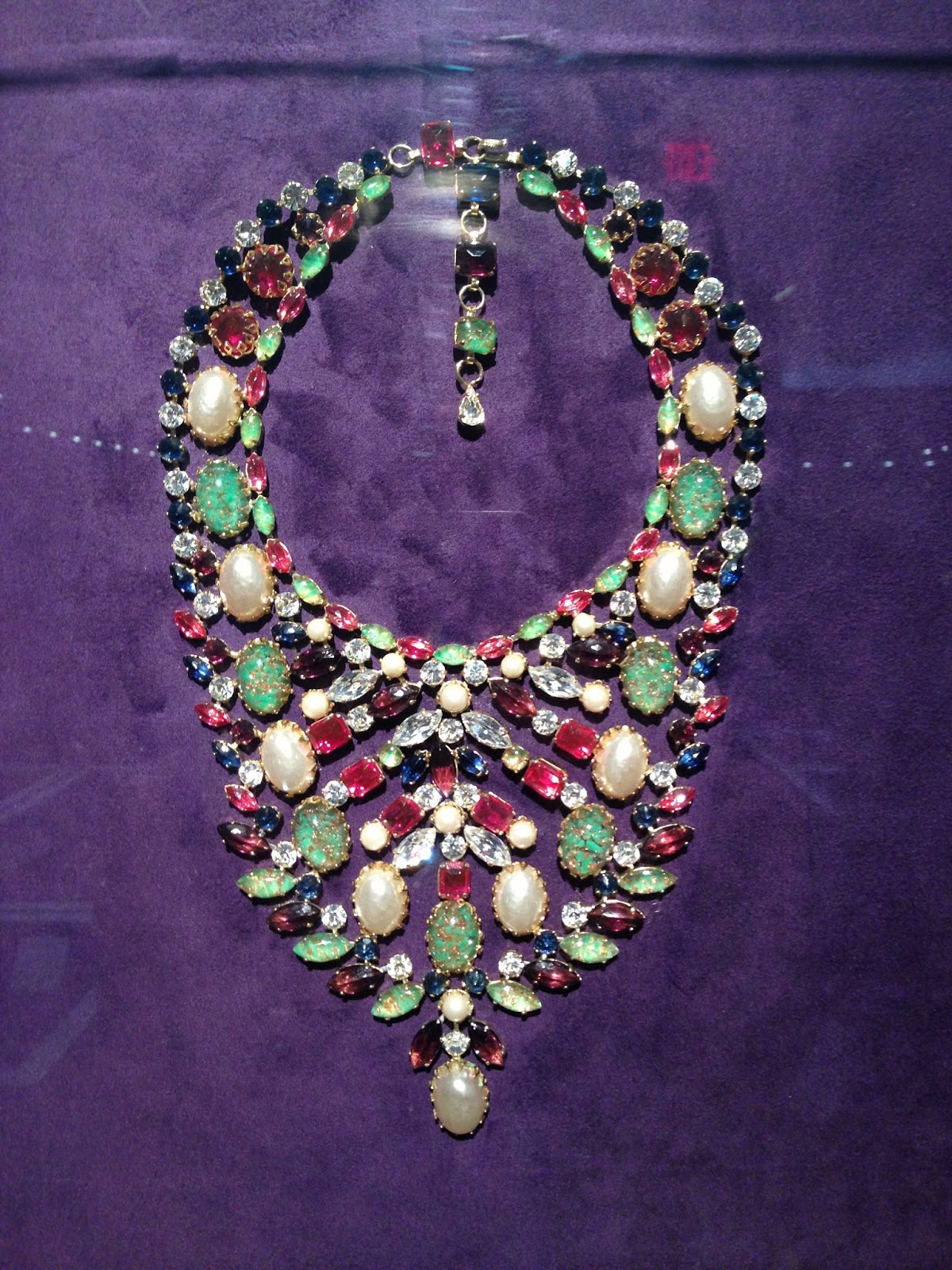
In my last entry, I wrote about gold filled jewelry, which is considered costume jewelry rather than fine jewelry, and I've got costume jewelry on the brain again this week after my recent visit to the Museum of Arts and Design for an truly fantastic exhibit of costume jewelry. The exhibit, titled Fashion Jewelry: The Collection of Barbara Berger, contained hundreds of pieces of costume jewelry made during the 20th century, as well as a group of more recent items. Fashion houses like Yves Saint Laurent and Dior designed and made many of the pieces. Other pieces were made by artists and talented craftsmen who made a name for themselves in costume jewelry, like those at New York company Trifari. The skills to make costume jewelry are quite similar as those to make fine jewelry, and the exhibit reminded me again why design and craftsmanship make jewelry beautiful, not just the materials used to make it. Berger’s pieces are exquisitely made and objects of true beauty. It was a pleasure to visit the exhibit, not only to see such an astounding collection, but to remember that a beautiful piece can always be worth adding to your collection, whether fine jewelry or costume. See below for some of the stunning pieces on display. 

William Delillo (USA) c. 1970 Glass, Lucite, Metal

William Delillo (USA) c. 1969 Glass, Metal

Top: Trifari (USA) c. 1940 Fruit Salad Bracelet, Glass, Metal
Bottom: Trifari TKF (USA) c. 1938 Glass, Metal

Schreiner (USA) c. 1960 Glass, Simulated Pearls, Metal


Monday, July 1, 2013

Gold Filled Jewels


Gold filled jewelry is abundant at Prather Beeland, and I wanted to share with you why we love it! 

Gold filled jewelry is a great and less expensive way to start collecting antique pieces. In the Victorian era, gold was expensive, but skilled craftsmen were not, allowing for beautiful pieces made with impeccable attention to detail but more affordable than pieces made of solid gold. Although the price tag made gold filled jewelry popular with middle class Victorians, the level of craftsmanship and time put into these pieces made them desirable to aristocrats and royalty as well. 

Gold filled jewelry is made using a rolled out layer of gold that is bonded to a base metal, often brass, with heat and pressure. This process leaves the pieces with a thicker layer of gold on the exterior compared to electroplating, a dipping technique that adds a very thin exterior layer of gold using electric currents.  Antique gold filled items have beautiful patina that comes with age, but the gold does not easily wear like gold plated items do.

Below are just some of the gold filled pieces available at Prather Beeland - we hope you'll love them as much as we do!


Thursday, May 16, 2013

All About Paste


Paste has for centuries been a popular and beautiful material used in costume jewelry. Made of flint glass, paste can be either clear or colored. In better quality paste pieces, like these Victorian English earrings, the stones are faceted and polished. Although more fragile than diamonds and other gemstones, paste still sparkles and has beautiful radiance. These earrings are 9K gold with three- part clusters of blue paste. Antique paste is highly collectible today and continues to be a wonderful substitute for diamonds and gemstones.

French jeweler Georges Frederic Strass invented clear paste in 1724, and it soon became all the rage, spreading in popularity to other countries, England in particular. Paste continued to be made through the 20th century, and was desirable in its own right, not just as a replacement for higher value stones. Pieces of lesser value were not made with less skill and craftsmanship. Jewelry continued to be made to the highest standards. These pieces were also not made for a lower class: royal and aristocratic woman wore paste pieces as well as their finer sets of jewels. Strass’s work was so admired in the court of Louis XIV of France that he was named the “King’s Jeweler,” and Marie Antoinette further popularized paste jewelry by wearing it at court.
            
Throughout history, people have been fascinated with recreating finer materials with less expensive options. These earrings represent a time of inventiveness in jewelry making and continue to be a fun, beautiful alternative!